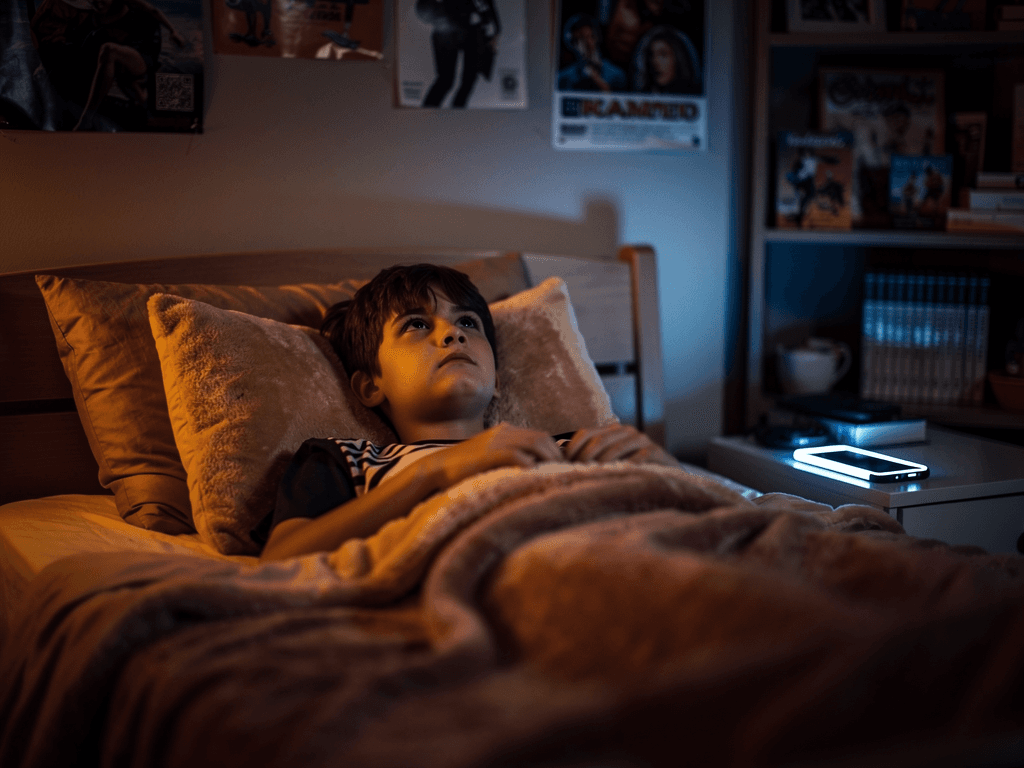
The blue light story is real. Screens emit wavelengths in the 400–490 nanometer range that the retina's photoreceptors are particularly sensitive to. Those photoreceptors signal the suprachiasmatic nucleus — the brain's light-dark clock — which suppresses melatonin production. Less melatonin means slower sleep onset. This is established biology.
But here's where it gets more complicated.
Does screen time before bed affect sleep?
Evening screen use is associated with delayed sleep onset in children and adolescents, primarily through blue light's effect on melatonin suppression and through cognitive and emotional stimulation that keeps the brain alert. Studies show consistent correlations between bedtime device use and later sleep times. However, simply removing devices often doesn't fully resolve the issue — the underlying stimulation and anxiety patterns driving device use also drive delayed sleep independently.
What the Studies Actually Find
The correlations are strong. Kids who use devices in the hour before bed fall asleep later, on average. They also report worse sleep quality and are more likely to feel tired the next day. Meta-analyses covering tens of thousands of children consistently show this pattern.
What's harder to establish is causation in the specific direction parents assume. Are kids sleeping worse because they're on screens? Or are kids who are anxious, stressed, or seeking social connection both using screens more AND sleeping worse — with screens as symptom rather than cause?
The answer is probably both. And that's what makes the intervention question harder than "take the phone away."
Several studies tracking teenagers who had devices removed versus those with negotiated device rules found something interesting: the removed-device group showed modest sleep improvements in the short term, but the effects didn't hold at 30 and 60 day follow-ups. The negotiated-agreement group showed smaller initial improvements that were more durable. Their compliance was higher, their anxiety around the intervention was lower, and — this is the part worth noting — they reported better family relationships around the topic.
What "Works" Depends on the Goal
If the goal is a child who falls asleep 20 minutes earlier for three weeks, a hard cutoff will probably get you there.
If the goal is a teenager who understands why sleep matters and develops habits that stick past high school — that's a different problem requiring a different approach.
Does taking away phones before bed improve sleep?
Removing devices at a set cutoff time reduces evening blue light exposure and can improve sleep onset by 15–30 minutes in studies with younger children. The effect is less consistent in adolescents, where resistance to enforcement increases compliance problems. Research suggests that agreements negotiated with the teen — rather than unilaterally imposed — produce more durable sleep improvements because they address the autonomy dimension driving device use patterns.
Teens are specifically at a developmental stage where autonomy matters. They're supposed to be pulling away, testing rules, wanting agency over their own choices. A hard screen cutoff imposed by a parent runs straight into that developmental current. That's not a parenting failure — it's just how adolescence works. And fighting that current with more enforcement tends to escalate rather than resolve.
The Part Nobody Talks About
Most screen time before bed isn't random stimulation. It's social. Teens are talking to their friends, managing relationships, processing the day. Taking that away at 9 PM doesn't eliminate the need — it just removes the outlet. The anxiety that was going into DMs now goes into lying awake in the dark.
That doesn't mean screens at midnight are fine. But it does mean the conversation about sleep and devices needs to include what kids are actually doing on them — and whether there's a way to support those needs that doesn't require a confrontation over a charging station.
What Actually Helps
The research consistently supports a few interventions:
Consistent sleep and wake times matter more than screen time rules. Irregular sleep schedules — late on weekends, early on weekdays — disrupt the circadian rhythm regardless of screen use. Getting that consistent is the highest-leverage sleep intervention available.
Agreements that kids participate in setting hold better than rules kids don't own. Not because kids are soft but because compliance is fundamentally behavioral, and behavior you chose is behavior you're more likely to maintain.
Dimming devices and enabling night modes reduces blue light exposure without requiring a full cutoff. This is low-friction and actually does something about the melatonin mechanism.
Having somewhere to charge devices outside the bedroom is consistently associated with better sleep — not because of the screen time reduction, but because it removes the temptation to reach for the phone at 2 AM when you wake up.
Tech Activity Pact is built around the negotiated-agreement approach. Parents and kids set screen time limits together — daily budgets, earn-more-time systems, categories that distinguish homework from TikTok. It's not parental controls. It's a family decision about how screens work in your household, with everyone's buy-in.
Coming to the App Store soon: treecitydbr.com/apps/screenpact