Why Parental Controls Backfire With Teenagers (And What Actually Works)
My neighbor's 14-year-old got a second phone.
Not bought it — found a cracked one at school, got a friend's dad to activate a prepaid SIM, and now uses it exclusively for TikTok and Discord. The original phone, the one with Family Link installed, stays pristine. School assignments. A few texts. Perfectly within limits.
This is not an unusual story. It's the natural endpoint of the arms race that hard parental controls start with any kid above about age 10.
The Enforcement Model Has a Fundamental Design Flaw
Apple Screen Time, Google Family Link, Circle, Bark — all of these products share one architectural assumption: the parent sets limits, the technology enforces them, the child complies.
That works until kids are clever enough to route around it. Which is younger than you think, and accelerating.
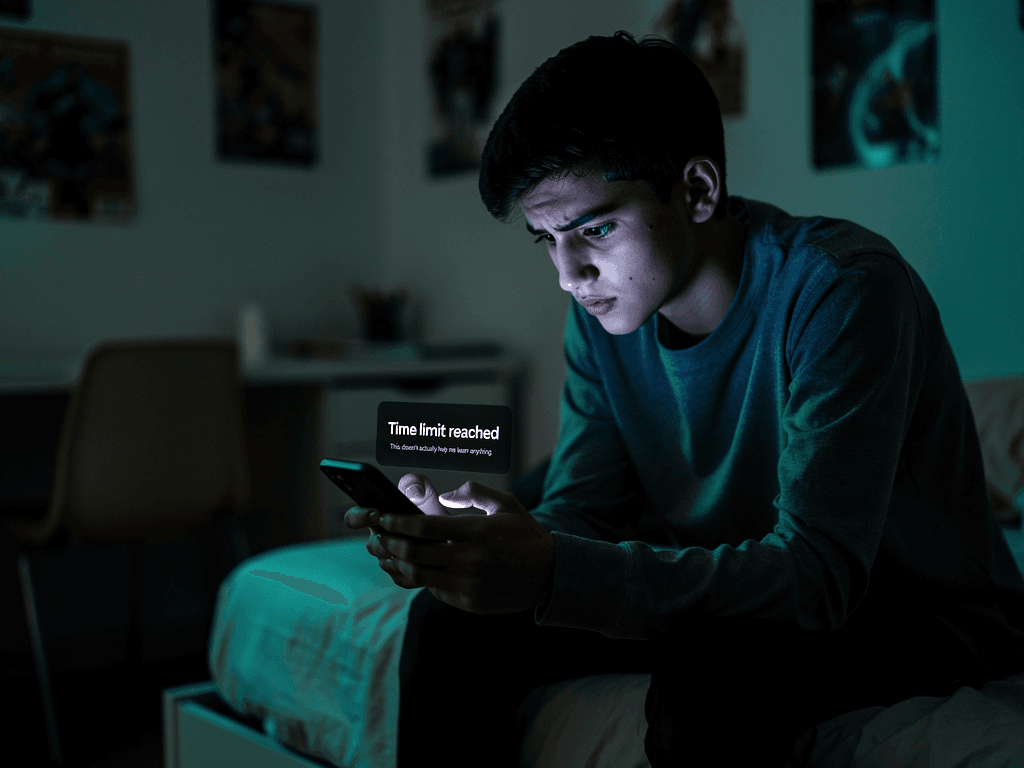
But here's the deeper problem: even when the controls hold technically, they generate resentment. Your teenager didn't learn to regulate their own screen time. They learned that phones get taken away at 9 PM. When they move out, they will have zero practice at self-regulation because they were never asked to exercise it.
What the Research Actually Says
Do collaborative screen time agreements work better than parental controls?
Research on adolescent self-regulation consistently shows that autonomy-supportive approaches — where teens participate in setting their own boundaries — produce better long-term outcomes than external control. A 2023 study in the Journal of Adolescent Health found that teens who co-created screen time rules with parents showed 40% higher compliance and significantly lower conflict around device use compared to teens with externally imposed limits.
This is not a surprise to anyone who has raised a teenager. The surprise is that our apps still don't reflect it.
The Agreement-First Model
TAP is built on a different premise: the rules should be a negotiation, not a decree.
The onboarding requires both parent and child to be present. Not just technically — the app asks both sides to agree on the parameters. What's a reasonable amount of entertainment screen time on a school night? What counts as educational use? What do you do with time leftover from the budget?
The questions are hard. Some families will disagree. That's the point.
The disagreement is the work. The app is just a structure for having it.
How the Earn System Changes the Dynamic
Hard limits say "you've used your time, stop." TAP says "you have a budget, here's how you're tracking, and here's how you can add to it."
Kids earn additional screen time by completing items from a shared family list: homework finished, dinner dishes done, reading for 20 minutes. Each action is worth a set number of minutes the family agreed on in advance.
This matters for a few reasons.
First: it ties screen time to real-world values instead of arbitrary clocks. Homework matters more than TikTok is a message that makes sense to most kids. The app just makes it concrete.
Second: it teaches time budgeting. When your 13-year-old has 45 minutes of entertainment time left and three hours of gaming they want to do, they have to make a real choice. That's a skill they'll need at 23 more than they'll need it now.
Third: parents stop being the police. The rules are the rules — agreed to by everyone, visible to everyone. When a teenager hits their limit, the response isn't "because I said so." It's "that's what we agreed on."
The Transparency Principle
TAP doesn't do secret monitoring.
No app usage reports sent only to parents. No background tracking that kids don't know about. The family dashboard is the same for everyone: what's the budget, what's been used, what's available, what can be earned.
We drew this line for practical and ethical reasons.
Practically: secret monitoring gets discovered. When it does, the breach of trust is worse than whatever the monitoring was protecting against.
Ethically: your 16-year-old is becoming an adult. They deserve to know the rules of their own house.
What This Doesn't Solve
TAP is not for families of young children. A 6-year-old doesn't negotiate screen time agreements. They need hard limits, and Apple Screen Time does that job adequately.
It's also not a fix for serious technology addiction. If your teenager is using their phone as a coping mechanism for anxiety or depression, the problem isn't the phone, and no app is the answer.
What TAP works for: families with kids roughly 10 and up who are past the "just say no" stage and aren't in crisis — they're just negotiating a normal adolescent transition toward independence. The app gives that negotiation structure.
A Note on the "Warden" Problem
Parents using hard parental controls often describe feeling like they're playing a role they hate: the enforcer. The kid comes to them not as a person but as a petitioner for screen time exceptions. Every conversation about devices is adversarial.
Families who move to an agreement model describe something different. The argument moved out of the relationship and into the policy. The policy can be renegotiated. The relationship doesn't have to absorb every screen-time conflict.
That's not a guarantee. Families are complicated. But it's what we built toward.
Try It Together
TAP launches with a Founding Family program — we're looking for families who want to help build the screen time app that should have existed years ago. You'll get TAP at a fraction of the retail price, locked for life. In return, you give us feedback as we build. The first 25 spots are the deepest partnership.
The tech is simple. The conversation it structures isn't. Start with what's reasonable and see what you both think.